
In situ magnetic-field stabilization for quantum-gas experiments
Ultracold quantum gases are a leading platform for quantum simulation with targets ranging from exotic materials to the expanding universe. That precision is also a vulnerability. For example, background magnetic fields shift the atoms’ internal energy levels, and even opening or closing a nearby door—or moving chairs in the laboratory—can disturb an experiment.
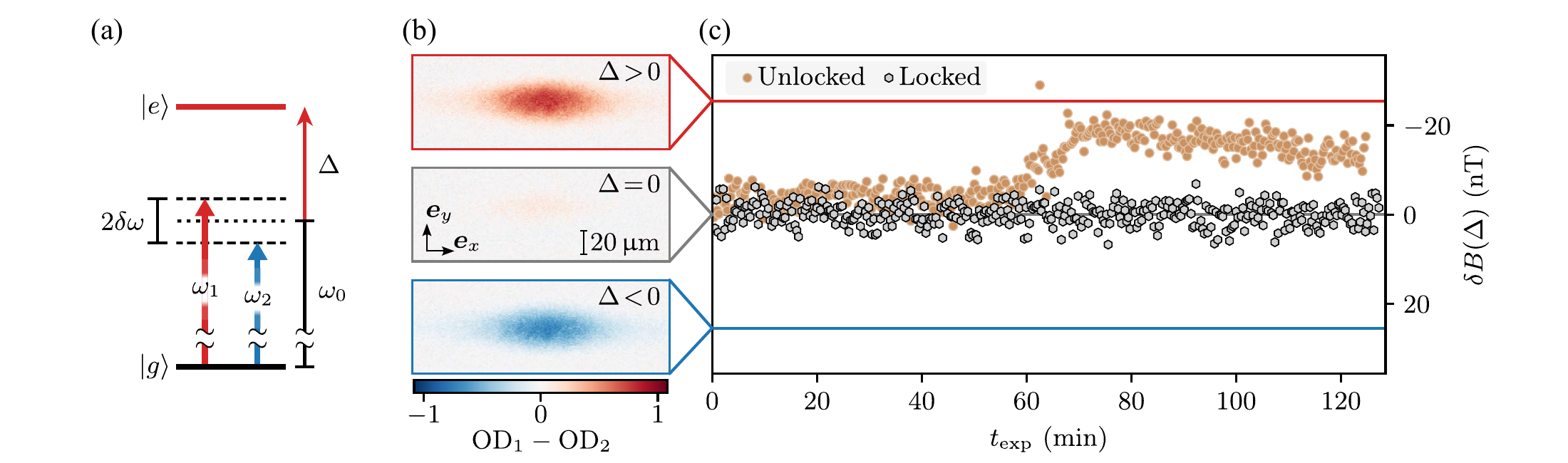
Here, we use the atoms as the sensor as well as the simulator. We apply two weak microwave pulses that each transfer only a small fraction of the atoms to a second internal state. The difference between those two small signals reveals whether the atomic transition—and therefore the magnetic field—is above or below its target value, while leaving most of the atomic sample available for the experiment.
We then feed this signal back to the magnetic-field coils through a Kalman filter, a calculation that continuously estimates the field’s drift. Without feedback, the ambient field drifted by as much as 70 nano-Tesla per hour. With the field locked, that long-term drift disappeared, at the cost of only a small increase in shot-to-shot variability from 1.8 to 2.0 nano-Tesla. Stabilizing the field at the atoms’ actual location, immediately before the experiment begins, makes a practical tool for quantum simulations of spin systems and for more stable neutral-atom quantum simulators and computers.
In situ magnetic-field stabilization for quantum-gas experiments; E. Gvozdiovas, A. Valdés-Curiel, Q.-Y. Liang, E. D. Mercado-Gutierrez, A. M. Piñeiro, J. Tao, D. Trypogeorgos, M. Zhao, and I. B. Spielman; Physical Review Applied 26 014104 (2026). doi:10.1103/vpnl-xpj7