
Nondestructive characterization of laser-cooled atoms using machine learning
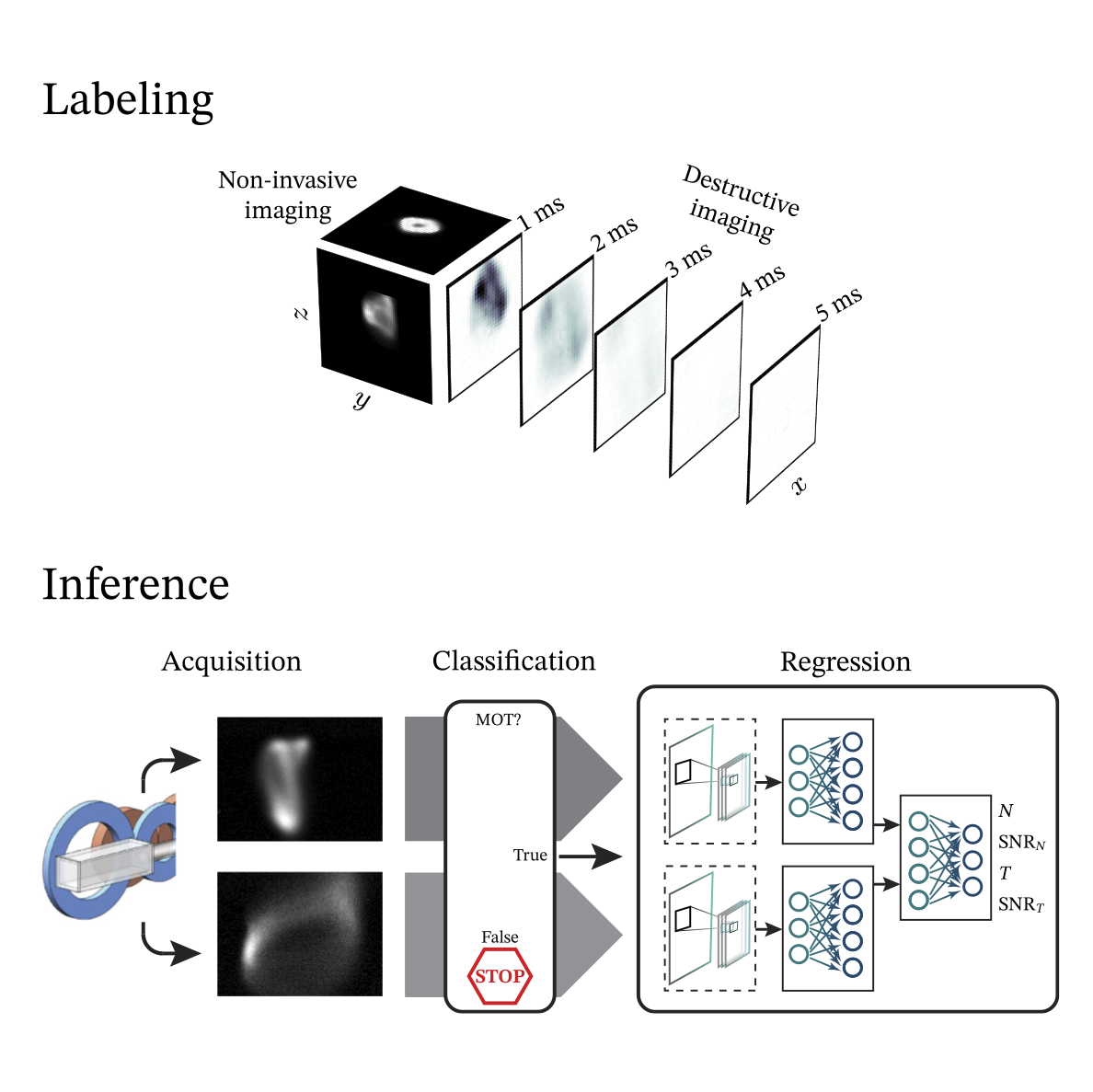
The magneto-optical trap (MOT) is a foundational laser-cooling and trapping tool used in modern atomic physics, with applications including atomic clocks and sensors as well as quantum simulators and computers. Before realizing these applications, researchers must have reliable laser cooling with stable number and temperature. The usual way to measure those quantities is to release the atoms, let them fly apart for a time, and image them; it works but is destructive because once measured, the sample is destroyed. Here, we show that machine learning (ML) can recover the same information from a much gentler signal: the fluorescence that atoms naturally emit while they are confined in an MOT. To the eye, these images reveal the cloud’s size and shape, but they do not obviously encode internal properties such as temperature. We built a labeled dataset by pairing fluorescence images of potassium-39 atom clouds with conventional destructive measurements, then trained ML models to infer atom number and temperature from the fluorescence images alone. Simple models that use only total brightness provide limited information, especially about temperature. By contrast, neural network models that can use spatial patterns across the images perform substantially better, showing that the fluorescence carries hidden information about the trapped atoms. In practice, this approach provides fast, nondestructive diagnostics for cold-atom experiments and supports real-time feedback in systems where repeatedly destroying the sample can be costly.
Nondestructive characterization of laser-cooled atoms using machine learning; G. de Sousa, M. Doris, D. D’Amato, B. Egleston, J. P. Zwolak, and I. B. Spielman; Newton 2 100518 (2026). doi:10.1016/j.newton.2026.100518.