
Imaginary Gauge Potentials in a Non-Hermitian Spin-Orbit Coupled Quantum Gas
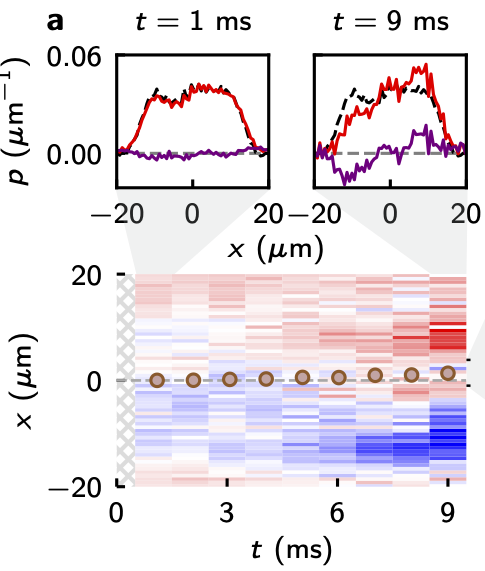
In 1996, Hatano and Nelson proposed a non-Hermitian lattice model containing an imaginary Peierls phase [Phys. Rev. Lett. 77, 570 (1996)], which subsequent analyses revealed to be an instance of a new class of topological systems. Here, we experimentally realize a continuum analog to this model containing an imaginary gauge potential using a homogeneous spin-orbit coupled Bose-Einstein condensate (BEC). Non-Hermiticity is introduced by adding tunable spin-dependent loss via microwave coupling to a subspace with spontaneous emission. We demonstrate that the resulting Heisenberg equations of motion for position and momentum depend explicitly on the system’s phase-space distribution. First, we observe collective nonreciprocal transport in real space, with a “self-acceleration” that decreases with the BEC’s spatial extent, consistent with non-Hermitian Gross-Pitaevskii simulations. We then examine localized edge states: the relatively strong interactions in our BEC suppress the formation of topological edge states, yielding instead highly excited states localized by an interplay between self-acceleration and wave function spreading. Finally, we confirm that our non-Hermitian description remains valid at all times by comparing it to a multilevel master equation treatment.
Imaginary gauge potentials in a non-Hermitian spin-orbit coupled quantum gas; J. Tao, E. D. Mercado-Gutierrez, M. Zhao, and I. B. Spielman; Phys. Rev. Lett. 136 113401 (2026). doi:10.1103/tpfc-n3bq; Featured as an Editors’ Suggestion.